Running a business inevitably involves repetitive work.
Someone copies information from an email into a spreadsheet. Another employee updates the same customer record in a second system. A manager waits for an approval before moving an order forward. Someone manually creates a weekly report. At the end of the month, a team member spends hours reconciling numbers across multiple platforms.
None of these tasks necessarily look like major problems individually.
Together, they can consume hundreds of hours every year.
If your team is constantly copying data between spreadsheets, chasing approvals over email, manually reconciling orders, or creating reports by hand, the problem usually isn't a lack of effort.
It may be a software gap.
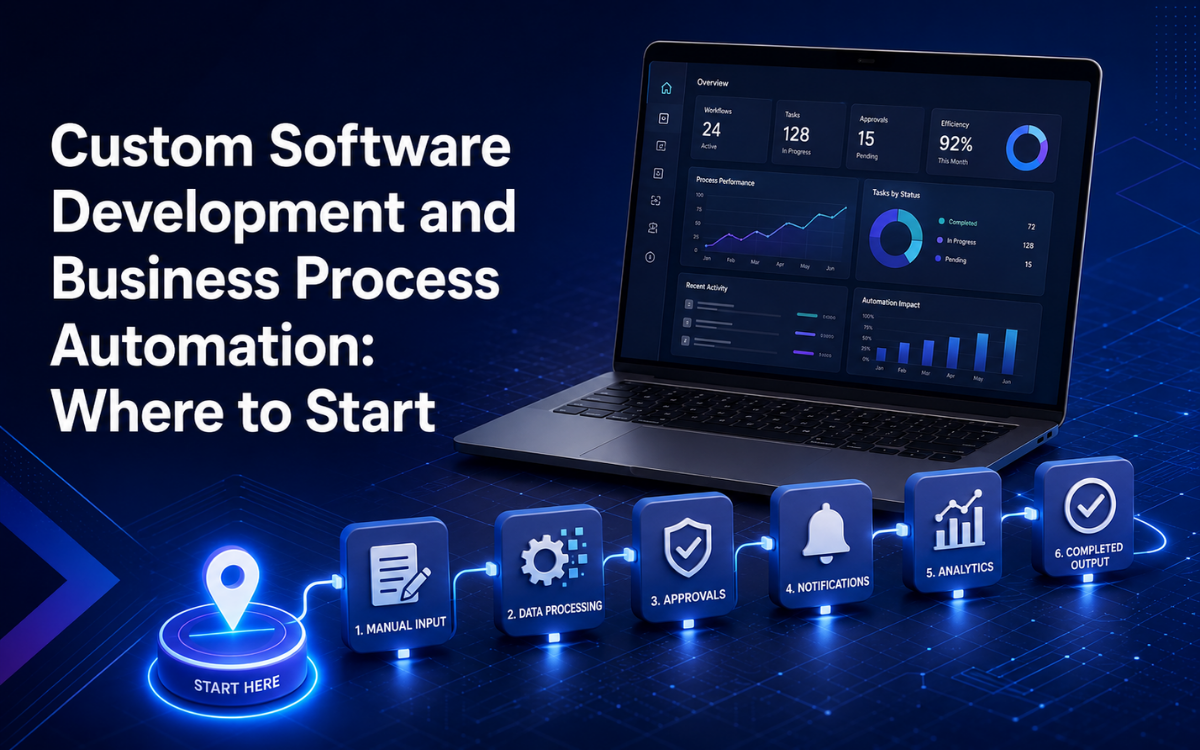
The right combination of custom business software development and business process automation software can transform repetitive manual workflows into structured, trackable processes while giving business owners greater visibility into daily operations.
The key is knowing where to start.
What Custom Business Software Actually Solves
Most businesses already use software.
You may have:
- A CRM for customer management
- Accounting software for finances
- Spreadsheets for inventory
- Email for communication
- Booking or order-management platforms
The issue often isn't a lack of software.
It's that the software doesn't fit together—or fit the way your business actually operates.
Off-the-Shelf Software Is Designed for the Average Business
Commercial software must serve a broad market.
As a result, it usually provides standardized workflows.
Your business, however, may have unique requirements involving:
- Order approvals
- Access permissions
- Customer assignment workflows
- Inventory updates
- Employee reporting
- Invoice generation
- Expense approvals
- Reporting processes
- Department communication
When software doesn't support those workflows, employees create workarounds.
Those workarounds often become:
- Spreadsheets
- Emails
- Chat messages
- Manual exports
- Informal processes
Eventually, businesses end up paying employees to compensate for software limitations.
Custom Software Changes the Direction
Custom business software development takes the opposite approach.
Instead of forcing employees to adapt to software, the software is built around the workflow.
The development process starts by understanding:
- How the business operates today
- Where information enters the process
- Who uses the information
- What decisions must be made
- Which tasks are repetitive
- Where mistakes occur
- Which systems need to communicate
- What improvements the business wants to achieve
The result is software that supports the organization instead of forcing the organization to adapt.
Signs Your Business Has a Software Gap
You don't necessarily need a massive digital transformation initiative to benefit from custom software.
Often, the warning signs are surprisingly simple.
Your Team Re-Enters the Same Data
If employees enter customer information into one system and manually copy it into another, there may be an opportunity for integration or automation.
Repeated data entry creates two problems:
Time
- Employees spend valuable hours on repetitive work.
Accuracy
- Every manual transfer introduces the possibility of human error.
If the same information exists in multiple systems, ask:
Can these systems share data automatically?
Approvals Happen Over Email
Email is excellent for communication.
It's not always ideal for workflow management.
Consider an approval process:
- An employee submits a request.
- A manager receives the email.
- The manager forgets to respond.
- The employee follows up.
- Another stakeholder asks for an update.
- The manager eventually approves.
- Someone updates a spreadsheet manually.
The process works—but it's difficult to track, audit, and optimize.
A custom workflow can automatically:
- Route requests
- Notify approvers
- Record decisions
- Update statuses
- Maintain an audit trail
Reports Are Created Manually
If someone spends hours every Monday gathering information from multiple systems to build reports, that process may be a strong automation candidate.
Instead of asking:
"Can someone prepare the numbers?"
Management should be able to ask:
"What are the numbers right now?"
A centralized dashboard can make that possible.
Customers Frequently Request Status Updates
Another common opportunity is customer communication.
If employees repeatedly answer questions such as:
- Has my order shipped?
- When is my appointment?
- Is my request approved?
- Has my application been processed?
- When will my service be completed?
then automation may provide significant value.
Customers receive information faster, while employees spend less time answering repetitive questions.
Business Process Automation Software in Practice
Automation doesn't necessarily mean replacing an entire business system.
In many cases, the best starting point is one repetitive process.
Business process automation software can automate predictable tasks based on rules, events, and data changes.
Automatically Generate Invoices
Instead of manually creating invoices, a system can automate the process.
Example:
Order Completed → Invoice Generated → Customer Notified → Accounting Updated
Benefits include:
- Reduced administration
- Improved consistency
- Faster processing
Automatically Route Approvals
Suppose expense approvals vary based on spending limits.
A workflow can automatically determine the appropriate approver.
Example:
Expense Submitted → Amount Checked → Correct Manager Notified → Approval Recorded
No manual routing required.
Synchronize Data Between Systems
Imagine a customer updates their phone number.
Without integration:
- CRM updated
- Billing system updated manually
- Customer support platform updated manually
With automation:
Customer Update → Systems Synchronize Automatically
This creates a more consistent customer record while reducing repetitive work.
Send Automatic Status Updates
Businesses can automate communication around key events.
Examples include:
- Booking confirmation emails
- Shipping notifications
- Appointment reminders
- Approval notifications
Small automations can create significant cumulative value.
The Compounding Value of Small Automations
One automation may save only 20 minutes per day.
That may not sound significant.
But imagine automation saves:
- 30 minutes daily on reporting
- 20 minutes daily on data entry
- 30 minutes daily on customer updates
- 1 hour weekly on approvals
- 2 hours weekly on reconciliation
The savings accumulate rapidly.
More importantly, employees spend less time on administrative tasks and more time on activities requiring human judgment.
Custom Dashboard for Business Management
Automation solves repetitive work.
A custom dashboard solves another challenge:
Visibility.
Many businesses have data spread across multiple systems.
For example:
- Sales in one platform
- Bookings in another
- Inventory in spreadsheets
- Customer data in a CRM
- Financial information in accounting software
The business may have plenty of information but no simple way to view what matters.
A custom dashboard can bring that information together.
What a Business Dashboard Can Show
Depending on the organization, dashboards may display:
Sales Metrics
- Daily sales
- Monthly revenue
- Sales by location
- Sales by product
- Average order value
- Revenue trends
Customer Metrics
- New customers
- Returning customers
- Retention rates
- Customer activity
- Acquisition performance
Operational Metrics
- Open orders
- Completed orders
- Pending tasks
- Processing times
- Operational bottlenecks
Inventory Metrics
- Current stock levels
- Low-stock alerts
- Fast-moving products
- Slow-moving inventory
- Inventory value
Staff Metrics
- Employee activity
- Completed tasks
- Productivity indicators
- Attendance
Booking Metrics
- Today's appointments
- Upcoming bookings
- Cancellations
- No-shows
- Capacity utilization
The goal isn't to show every available number.
The goal is to show information that helps someone make a decision.
A Good Dashboard Is More Than a Collection of Charts
Many dashboards look impressive.
Far fewer are actually useful.
A business dashboard should answer questions quickly:
- How much did we sell today?
- Which products are running low?
- How many bookings do we have tomorrow?
- Which orders are delayed?
- Which locations are performing best?
- What requires attention right now?
If management must interpret dozens of charts before understanding what matters, the dashboard isn't solving the problem.
Clarity should always come first.
Give the Most Important Information Priority
Most businesses have dozens of available metrics.
The home screen should focus on the most important ones.
Examples include:
- Today's Revenue
- Pending Orders
- Low Inventory Alerts
- Today's Bookings
- Outstanding Approvals
- Customer Issues
Everything else can be accessed through secondary views.
This transforms a dashboard from a reporting tool into a daily management system.
How Automation and Dashboards Work Together
Automation and dashboards become even more powerful when combined.
Without Automation
Order Received → Employee Checks Email → Spreadsheet Updated → Warehouse Notified → Customer Updated
With Automation
Order Received → System Records Order → Warehouse Notified → Status Updated → Customer Notified
The dashboard can immediately display:
- New Orders: 24
- Processing: 17
- Shipped: 32
- Delayed: 3
Management gains visibility while employees spend less time moving information around.
Where Should You Start?
The biggest automation mistake is trying to automate everything at once.
You don't need to automate every workflow.
You need to identify the highest-value bottleneck.
Strong automation candidates often:
- Happen frequently
- Consume significant time
- Require repetitive data entry
- Cause recurring errors
- Require multiple approvals
- Depend on spreadsheets
- Pull data from multiple systems
- Create customer delays
- Limit management visibility
The more of these characteristics a process has, the stronger the business case for automation.
Step-by-Step: Identifying Your First Automation Opportunity
Step 1: List Repetitive Processes
Document recurring tasks such as:
- Creating reports
- Sending reminders
- Updating spreadsheets
- Approving requests
- Creating invoices
- Updating customer records
- Reconciling orders
- Assigning employees
- Sending status updates
Step 2: Estimate the Time
Ask:
- How often does this occur?
- How much time does it take?
A task that consumes only 15 minutes may become significant if it happens dozens of times daily.
Step 3: Look at Errors
Time isn't the only cost.
Consider:
- Incorrect invoices
- Duplicate customer records
- Inventory discrepancies
- Missed approvals
- Incorrect statuses
- Delayed notifications
Automation can improve consistency while reducing mistakes.
Step 4: Map the Workflow
Before development begins, document the process.
Example:
Customer Places Order
↓
Payment Confirmed
↓
Order Assigned
↓
Warehouse Prepares Order
↓
Order Shipped
↓
Tracking Sent
↓
Order Completed
Once workflows are visible, automation opportunities become much easier to identify.
Step 5: Define the Desired Outcome
Don't start with:
"We need an automated system."
Start with:
"We want every paid order to automatically reach the warehouse and send the customer a confirmation without staff intervention."
That's a clear development objective.
Custom Software Doesn't Mean Rebuilding Everything
Many business owners assume custom software means replacing every existing system.
It doesn't.
Often, the best solution is connecting tools you already use.
For example:
CRM + Accounting Software + Payment Platform + Custom Dashboard
The custom software acts as a bridge between systems.
This can be significantly more practical than replacing everything.
When Custom Software Makes Sense
Sometimes an existing SaaS product is the right answer.
Custom software becomes more valuable when:
- Workflows are highly specialized
- Existing tools require excessive workarounds
- Multiple systems need integration
- Unique business rules exist
- Reporting requirements are unusual
- Proprietary processes matter
- Teams spend excessive time on administration
- Full product control is important
The decision should always be based on business value.
Build in Phases
Most businesses need less custom software than they think.
A practical roadmap might look like:
Phase 1
Automate invoice generation.
Phase 2
Connect customer and payment systems.
Phase 3
Launch a management dashboard.
Phase 4
Automate customer notifications.
Phase 5
Add advanced reporting and analytics.
An incremental approach reduces risk and helps validate results at each stage.
Security and Access Control Matter
Business automation often involves sensitive information.
Custom systems may contain:
- Customer records
- Financial data
- Employee information
- Inventory data
- Internal documents
- Operational metrics
Important security measures may include:
- User authentication
- Role-based permissions
- Secure data transmission
- Access controls
- Activity logging
- Backups
- Monitoring
Not every employee needs access to every piece of information.
Role-based permissions help keep systems secure and organized.
How to Measure Success
A successful automation project should produce measurable results.
Before implementation, establish a baseline.
Example:
Before
- Process Time: 15 hours per week
- Error Rate: 5%
- Response Time: 6 hours
After
- Process Time: 3 hours per week
- Error Rate: 1%
- Response Time: 15 minutes
The goal is to improve outcomes—not simply add software.
Common Mistakes to Avoid
Mistake 1: Automating a Bad Process
Automation doesn't automatically improve a flawed workflow.
Improve the process first.
Then automate it.
Mistake 2: Automating Everything at Once
Large projects become difficult to manage.
Start small.
Prove value.
Expand gradually.
Mistake 3: Ignoring Employees
The people performing the work often understand the problems best.
Ask them:
- What takes the most time?
- Where do errors occur?
- What information is repeatedly entered?
- What requires manual checking?
- What frustrates customers?
Their insights often reveal the best automation opportunities.
Mistake 4: Building a Dashboard Nobody Uses
A dashboard is successful when someone can open it and immediately understand what requires attention.
Focus on decisions, not decoration.
Why SpeckPro Starts With the Workflow
At SpeckPro, custom software development begins by understanding how the business actually operates.
Before development starts, important questions include:
- How does the business work today?
- Where is time being lost?
- Where do errors occur?
- Which systems need to communicate?
- What information does management need?
- Which process should be improved first?
From there, technology is designed around the business.
That may involve:
- Custom internal software
- Business process automation
- System integrations
- Management dashboards
- Workflow optimization
The objective is practical:
Reduce manual work, improve visibility, and create software that supports the way the business actually operates.
Don't Automate Everything—Automate the Right Thing
Business automation doesn't need to begin with a massive technology initiative.
The best starting point is often surprisingly small.
Find:
- The process consuming the most time
- The workflow creating the most errors
- The task employees repeat daily
- The information management can't easily access
Then solve that problem first.
Over time, several small improvements can become a connected business system:
Automated Workflows → Integrated Data → Centralized Dashboard → Better Decisions
That's the real value of custom business software development.
Not more technology.
Better workflows, better information, and software that fits the business.
If you're considering custom software, the best first conversation isn't about features or programming languages—it's about your workflow.
Frequently Asked Questions
What is custom business software development?
Custom business software development involves creating software tailored to a company's specific workflows, business rules, and operational requirements instead of relying solely on generic off-the-shelf solutions.
What is business process automation software?
Business process automation software automates repetitive tasks such as approvals, notifications, reporting, data synchronization, and workflow management to reduce manual effort and improve efficiency.
When should a business invest in custom software?
Businesses should consider custom software when existing systems require significant workarounds, multiple platforms need integration, manual processes consume excessive time, or specialized workflows cannot be supported effectively by off-the-shelf tools.
What is a custom business dashboard?
A custom business dashboard combines data from multiple systems into a centralized interface, allowing managers and owners to monitor operations, sales, inventory, customers, and performance metrics in real time.
How do you identify the best automation opportunity?
Start by identifying processes that happen frequently, consume significant time, involve repetitive data entry, create frequent errors, depend on spreadsheets, or delay customers. These workflows often deliver the strongest return on automation investment.
SpeckPro Editorial Team
Software DevelopmentNotes from the SpeckPro team on building, improving, and scaling digital products.